
QSight 420MD Dual Ion Source Technology: ESI and APCI at Your Command
Liquid Chromatography-Tandem Mass Spectrometry (LC-MS/MS) is a powerful analytical technique widely applied in life sciences, chemistry, and medicine. In LC-MS/MS, the selection and design of the ion source are crucial for overall analytical sensitivity and selectivity.
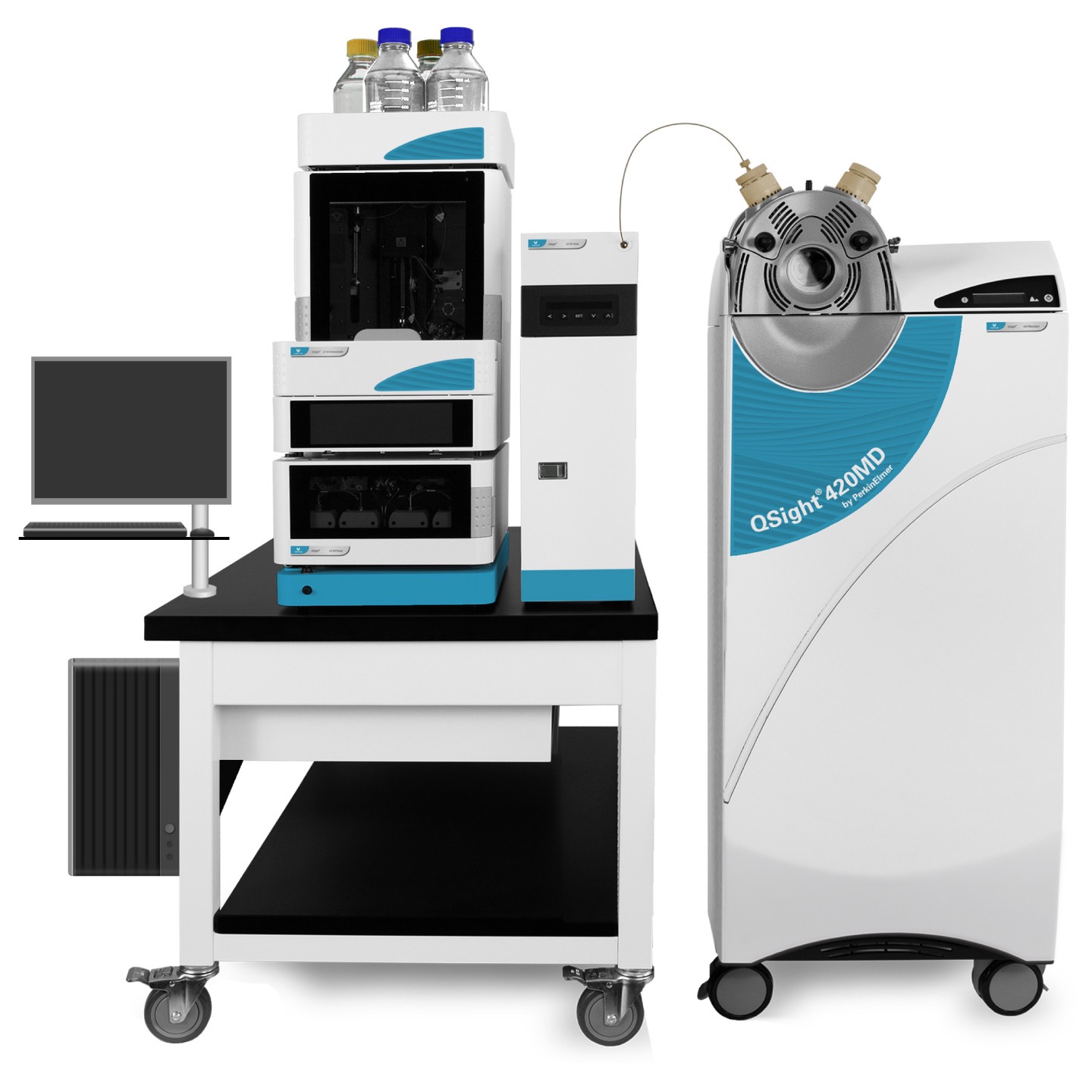
QSight 420MD Dual Ion Source System
The QSight 420MD dual ion source system from Virtue Diagnostics consists of two completely independent ion sources: Electrospray Ionization (ESI) and Atmospheric Pressure Chemical Ionization (APCI). This article introduces their working principles, applications, and advantages.
I. ESI Ion Source
ESI ion source is a highly efficient and stable ionization technique. Its working principle involves three steps: Ionization → Spray → Evaporation.
ESI belongs to liquid-phase ionization. It utilizes an electric field and nitrogen gas flow to produce charged droplets, then uses heated gas for desolvation to produce charged analytes.
Main Components of ESI Ion Source
II. APCI Ion Source
Unlike ESI, the working principle of APCI ion source is Spray-Evaporation-Ionization. APCI belongs to gas-phase ionization.
It first desolvates the liquid in a high-temperature heater, then produces charged analytes through corona needle discharge and charge transfer before introducing them into the mass spectrometer for detection and analysis.
III. ESI vs APCI Comparison
| Feature | ESI Ion Source | APCI Ion Source |
|---|---|---|
| Principle | Uses ion evaporation, belongs to liquid-phase ionization | Uses corona needle discharge, belongs to gas-phase ionization |
| Applicability | Suitable for polar compounds and biomolecules (large molecules) | Suitable for weakly polar small molecule compounds |
| Multiple Charges | Can generate multiply charged ions, suitable for large molecules | Cannot generate multiply charged ions, mainly produces singly charged ions |
| Characteristics | High ionization efficiency. Stable ion generation. Requires high-purity solvents. | Lower ionization efficiency. Strong sample adaptability. Prone to molecular fragmentation. |
IV. Advantages of Dual Ion Source
High Throughput: The ion source can be switched without tools, simply by a "one-click switch" in the software. This significantly increases mass spectrometry detection throughput, improves efficiency, and saves time.
High Sensitivity: The dual ion source can increase analytical sensitivity several times over, particularly for compounds that are difficult to ionize and for low-concentration samples.
Broad Applicability: Since different molecules possess different chemical and physical properties, ESI and APCI are each suitable for different compound classes. The dual ion source provides more comprehensive coverage for different types of compounds.
Fast Analysis: Allows for rapid switching between four ionization modes (ESI+, ESI-, APCI+, and APCI-) within a single method during a single injection, simultaneously acquiring data from each ionization mode.
V. 2002 Nobel Prize in Chemistry
John B. Fenn - Inventor of ESI
John B. Fenn was an American chemist and one of the inventors of Electrospray Mass Spectrometry (ESI-MS) technology. The invention of the ESI ion source technology laid an important foundation for the development of modern mass spectrometry.
